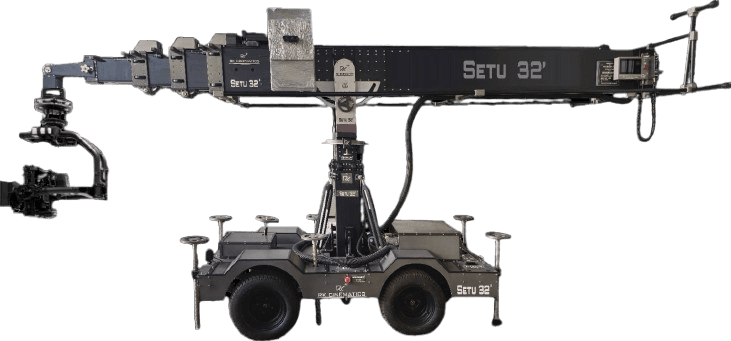
The Evolution of Motion: Understanding Telescopic Camera Cranes
In the world of high-end cinematography, the telescopic camera crane stands as the pinnacle of camera movement technology. Unlike traditional fixed-arm cranes (or "jibs") that move in a fixed arc, a telescopic crane allows the arm itself to extend and retract smoothly during a shot.
This capability transforms how directors and cinematographers approach storytelling, offering a level of precision and fluid motion that was once impossible.
Key Features and Capabilities
Telescopic cranes, such as those developed by RK Cinematics, provide several distinct advantages on set:
- Linear Movement: The crane can move the camera in a straight line toward or away from a subject by extending the arm, eliminating the "arching" motion of standard jibs.
- Space Efficiency: Because the arm retracts, these cranes can operate in tight indoor spaces where a long, fixed beam would hit walls or lighting grids.
- High Payload Capacity: Advanced models are engineered to carry heavy professional camera rigs and stabilized heads, often supporting significant weight while maintaining balance.
- All-Terrain Adaptability: Many modern systems feature adjustable pneumatic tires, allowing for stability and "gliding" movement across uneven outdoor surfaces.
Why Filmmakers Use Them
The primary draw of a telescopic crane is the "Technocrane" effect. It allows for a single, continuous shot that begins as a wide overhead view and "telescopes" down into a tight close-up without any jerky transitions.

Written by Gaurav Gajjar
March 6, 2026